How to Declutter without Shame or Decision Fatigue with Kathi Lipp
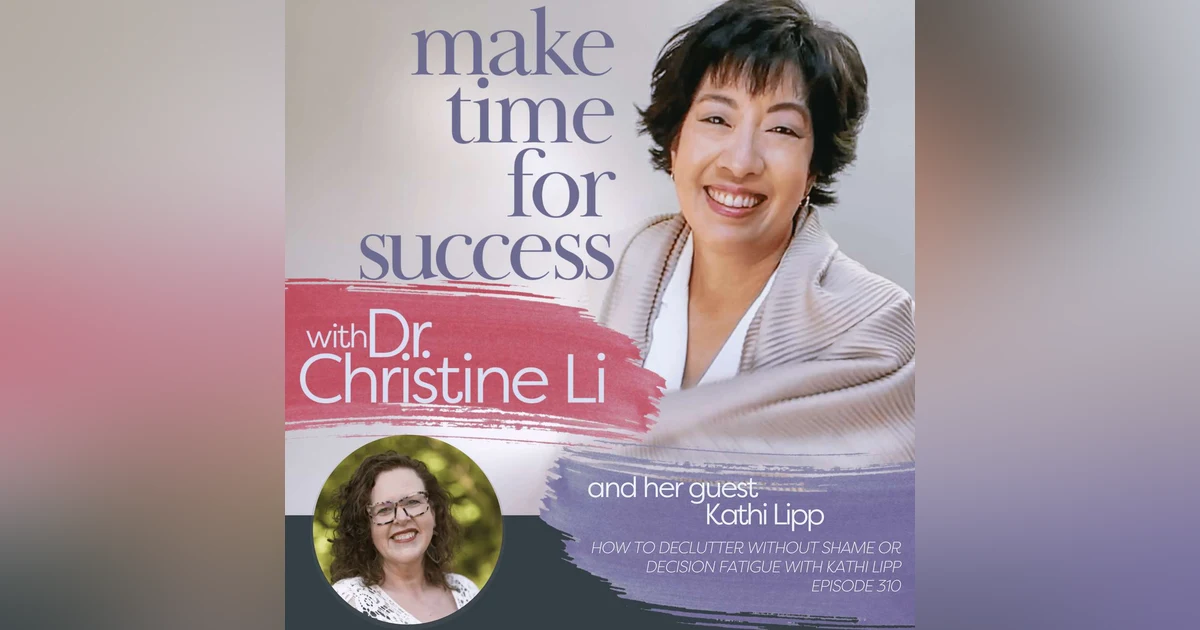

Send Dr. Li a text here. Please leave your email address if you would like a reply, thanks. In this episode, Dr. Christine Li sits down with decluttering expert and Clutter-Free Academy founder Kathi Lipp to discuss practical, shame-free strategies for tackling clutter. They delve into Kathi Lipp’s 3 Boxes, 2 Bags system, the power of community support, and why kindness—rather than perfectionism and shame—leads to progress. Expect relatable stories, uplifting advice, and actionable tips to he...

 Apple Podcasts

 Spotify

 Amazon Music

 Castro

 Castbox

 Podchaser

 Deezer

 Podcast Addict

 RSS Feed

 YouTube
Send Dr. Li a text here. Please leave your email address if you would like a reply, thanks.
In this episode, Dr. Christine Li sits down with decluttering expert and Clutter-Free Academy founder Kathi Lipp to discuss practical, shame-free strategies for tackling clutter. They delve into Kathi Lipp’s 3 Boxes, 2 Bags system, the power of community support, and why kindness—rather than perfectionism and shame—leads to progress. Expect relatable stories, uplifting advice, and actionable tips to help make your decluttering journey both manageable and empowering.
Through her books, podcasts, 100,000 social media followers and 20,000 strong Clutter Free Academy Facebook group, Kathi helps women trade household chaos for breathing room, without shame, perfectionism, or the expectation that they'll suddenly become their naturally organized neighbor.
Timestamps
- 00:00:00: Dr. Christine Li introduces the episode and Kathi Lipp, focusing on decluttering.
- 00:03:16: Kathi Lipp shares her background and details the "30-Day 1K" decluttering challenge.
- 00:05:06: Kathi Lipp describes growing up with clutter and her journey to find gentler decluttering strategies.
- 00:07:18: Kathi Lipp explains building a shame-free community and writing Clutter Free.
- 00:08:28: Dr. Christine Li asks about group decluttering and connection.
- 00:09:55: Kathi Lipp outlines the power of accountability and support in decluttering sessions.
- 00:11:21: Kathi Lipp and Dr. Christine Li discuss how decluttering fosters emotional relief and reduces decision fatigue.
- 00:14:05: Kathi Lipp links decluttering progress to increased creativity and productivity.
- 00:16:08: Self-kindness and overcoming perfectionism discussed.
- 00:18:08: Both admit ongoing struggles with clutter and the importance of acceptance.
- 00:19:16: Kathi Lipp recounts a shaming experience and stresses kindness over shame.
- 00:23:28: Dr. Christine Li prompts a discussion of Clutter Free’s key methods.
- 00:24:12: Kathi Lipp explains her "3 Boxes, 2 Bags" decluttering framework.
- 00:26:22: Kathi Lipp talks about simple routines and adapting through challenges like long COVID.
- 00:30:25: Dr. Christine Li inquires about the impact of removing 1,000 items.
- 00:30:34: Kathi Lipp describes how the process recalibrates the home and brings peace.
- 00:34:43: Kathi Lipp shares a free resource on decluttering systems.
- 00:36:18: Dr. Christine Li closes with info on accessing free tools and connecting online.
To get the free download that accompanies this episode, go to: https://maketimeforsuccesspodcast.com/boxes
To sign up for the Waitlist for the Simply Productive Program, go to https://maketimeforsuccesspodcast.com/SP
For more information on the Make Time for Success podcast, visit: https://www.maketimeforsuccesspodcast.com
Gain Access to Dr. Christine Li’s Free Resource Library -- 12 downloadable tools and templates to help you bypass the impulse to procrastinate: https://procrastinationcoach.mykajabi.com/freelibrary
To work with Dr. Li on a weekly basis in her coaching and accountability program, register for The Success Lab here: https://www.procrastinationcoach.com/lab
Connect with Us!
Dr. Christine Li
- Website: https://www.procrastinationcoach.com
- Facebook Group: https://www.facebook.com/groups/procrastinationcoach
- Instagram: https://www.instagram.com/procrastinationcoach/
- TikTok: https://www.tiktok.com/@procrastinationcoach
- The Success Lab: https://maketimeforsuccesspodcast.com/lab
- Simply Productive: https://maketimeforsuccesspodcast.com/SP
Kathi Lipp
- Website: https://www.kathilipp.com/
- Instagram: https://www.instagram.com/kathilipp/
- Facebook: https://www.facebook.com/AuthorKathiLipp/
- Tiktok: https://www.tiktok.com/@kathilipp
- Podcast: https://podcast.kathilipp.com/cfa/podcast
Dr. Christine Li [00:00:00]:
Welcome back to the Make Time for Success podcast. This is episode number 310. Well, I've finally done it. I have found someone online who really could be my partner in crime when it comes to fighting the clutter. Her name is Kathy Lipp, and she very kindly the other night agreed to talk to a total stranger who is me here on the podcast. And we're going to talk all about sane strategies for getting rid of your clutter. And she has her own system. It's the 3 Boxes, 2 Bags system, which will help you to declutter without running all over your house to put things away and make yourself nuts.
Dr. Christine Li [00:00:45]:
So that's something that you can look forward to in this episode. She and I share a love of '70s music, it turns out, and we both also teach decluttering while also admitting to having a bit of clutter ourselves. We both use a very honest and strategic approach. We have strategies that work, and I'm so grateful to Kathy for coming onto the podcast so that we can hear about her approach. Kathy is the founder of Clutter-Free Academy. She has also written many, many books But 2 of them are called Clutter Free and Clutter Free Home. She helps creative, overwhelmed women to stop fighting with the clutter and their homes and their natural tendencies so that they can create homes that really work for them and their personalities. She is a hoot.
Dr. Christine Li [00:01:40]:
She's really lovely. She's so funny and just real. And I think you're going to love her and you're going to love this episode. Let's go listen to it together now. Hi, I'm Dr. Christine Li, and I'm a psychologist and a procrastination coach. I've helped thousands of people move past procrastination and overwhelm so they could begin working to their potential. In this podcast, you're going to learn powerful strategies for getting your mind, body, and energy to work together so that you can focus on what's really important and accomplish the goals you want to achieve.
Dr. Christine Li [00:02:24]:
When you start living within your full power, you're going to see how being productive can be easy and how you can create success on demand. Welcome to the Make Time for Success podcast. Hi everyone. Welcome back. And I am joined today by my new friend, Kathy Lipp, who I invited onto the podcast probably 2 nights ago, late evening. We didn't know each other, and I just saw one post of hers on one of the social media channels, and I said, let's bring her onto the show. So Kathy, thank you for just saying yes to that wacky invitation and for being who you are. And we have a lot in common and a lot of shared interests.
Dr. Christine Li [00:03:16]:
So why don't you start us off by giving us a sense of who you are and what you had said on that post?
Kathi Lipp [00:03:23]:
Yeah. So first of all, Christine, I am so excited to be here because I started following you maybe a month, 2 months ago. And I'm like, I, I like this vibe. This is exactly what I need. And I love the science behind it. So all of that makes my, my itchy brain, it scratches it in all the right ways.
Dr. Christine Li [00:03:47]:
Great. Thank you.
Kathi Lipp [00:03:47]:
And on that Instagram post, every November we do something in our Facebook group. It's called a 30-Day 1K where we're getting rid of 1,000 pieces of clutter in 30 days. And so it, it's a big challenge. You know, it's about 34, 35 pieces of clutter a day. But for me and for my members, being able to get that running up to the holidays is a really good feeling. And I know a lot of the people that I work with, they just want to overhaul their whole house in one, you know, they want to take a Saturday and just do it. And this is, this is still challenging, but doable and it doesn't burn you out. So that was the challenge.
Kathi Lipp [00:04:35]:
I invited people. on Instagram to follow along and do it just from their own homes. And it's been so fun watching people get rid, you know, feel like they can finally do something about their clutter.
Dr. Christine Li [00:04:48]:
That is terrific. I can't wait to see that. I can't wait to visit in. And I have a feeling I'm gonna start participating as well myself. Could you tell us about yourself and how you got to be in the situation of creating this kind of challenge And anything you wanna share with us about who you are.
Kathi Lipp [00:05:06]:
Yeah. So I grew up in Silicon Valley and I grew up in a home divided. My mom was trying to maintain everything and my dad was the clutteriest person I knew. We were the people that never opened their garage door because it was so embarrassing. And I grew up like that. And then when I was living on my own, I lived a year in Japan and I was able to maintain that. But once getting married and starting to have some kids, I just felt completely overwhelmed, out of control. I didn't have the skills or the tools.
Kathi Lipp [00:05:51]:
And, you know, anytime I would do that big overhaul, it just felt like it all fell apart. Within a few days. And so it, it, I got to the why even bother, bother about any of this. In around 2005, I got remarried and I, I decided I need to figure this out. I need to understand why I am like this. And I have a very gracious husband, but he is naturally not a cluttery person and I'm I'm chaotic sometimes. That's just how my brain is. And I started to realize the overhaul wasn't working for me.
Kathi Lipp [00:06:31]:
You know, the, we're going to clean this pit out because that was just coming from a place of shame all the time. I was ashamed all the time.
Dr. Christine Li [00:06:40]:
Mm-hmm.
Kathi Lipp [00:06:40]:
And so I finally said, you know, I, I had done this with exercise. I had done this with studying. What if I just started with a few minutes? And it turns out you can get a lot done in a few minutes when you're super focused. And so that's, that's how it all started. And I started to share with some friends, and we ended up going to each other's houses for like 3 hours at a time. There were 4 friends. One would watch the kids and the others would declutter. And it made a real difference in our lives.
Kathi Lipp [00:07:18]:
And I just started to share that. I wrote a book about it called Clutter Free, and it just grew from there. And I feel like we are a safe place on the internet because when you start to talk about clutter, people are very shaming. And, you know, just don't be so lazy. Why can't you be more organized? And we just needed a safe place to say, hey, I get you, friend. Don't be ashamed. We're The first step is to want to do something. And so we all want to do this together.
Dr. Christine Li [00:07:50]:
I love that. I feel like that could be a TV drama or TV reality show. Probably—
Kathi Lipp [00:07:56]:
I know, right?
Dr. Christine Li [00:07:57]:
There's probably some version of that. But I love that you came together to help each other and with built-in childcare too. It's ingenious. That's great.
Kathi Lipp [00:08:06]:
And, you know, I'm sure you've seen this study, I believe it was from UCLA, that 66% of women say that Clutter is a big issue in their lives. So why are we experiencing so much shame when our neighbor is in the same boat, when our best friend is in the same boat? You know, so we had to figure out a new system.
Dr. Christine Li [00:08:28]:
Okay, terrific. So thank you for sharing that. We were talking a bit before we pressed record. You really feel that connecting with other people around decluttering is an essential key way to succeed. Could you tell us a little bit more about that philosophy? And are there rules? Are there, are there expectations? Are there contracts? What do you do?
Kathi Lipp [00:08:55]:
Right. Well, so I'm also a writer and the things I struggle with, clutter and writing, you know, of course, right? The things you long to do to have a peaceful home and to write books are are our biggest struggles. And I had seen for my son who really struggled in school, when he got together with a couple of his friends and they would just sit down and they would not even work together, but work independently near each other, he was so much more focused. And I wasn't constantly saying, Justin, you need to pay, you know, Justin, get back to your work. Like he was just focused. So what we start— I started it with writing. where I would get on Zoom with a few friends and we would spend the first 5 minutes, what are you going to work on? What are you going to work on? We would just state it. And then at the end of the hour, for the last 5 minutes, what'd you get done? And there was no shame.
Kathi Lipp [00:09:56]:
You know, sometimes the dog needed to go for a walk and no writing happened, but more times than not, so much more was accomplished in that time. And so one of the things we've started doing in our Clutter-Free Group Is we, we do a decluttering time together. And there, you know, there are anytime between 10 and 30 people on a call and it's an hour and we just say, hey, what are you going to work on? And people type it out. We keep the cameras on for the most part. Some people keep their cameras off because they're, they're still embarrassed about their space. And it was like, hey, we're not here to expose anybody. We just want to be an encouragement. And so they can either just declutter for 15 minutes on what they want, or I will call out little assignments.
Kathi Lipp [00:10:47]:
You know, hey, for the next 10 minutes, can you get rid of 20 pieces of paper that may be in your area that you just haven't been able to focus on yet? Or maybe you need to spend the next 5 minutes gathering up everything that needs to be brought into the kitchen. We're going to give you 5 minutes to do that. But it's just a way to really lessen that shame. And say, you're not weird, you're not defective. You, you just live a complicated life like we all do.
Dr. Christine Li [00:11:21]:
Mm-hmm. Mm-hmm. It is about the feelings, isn't it?
Kathi Lipp [00:11:24]:
It's so about the feelings. Yes.
Dr. Christine Li [00:11:27]:
All right. Let's talk more about the feelings. If we could start with what happened to you when you got together with your friends, the daycare, the childcare was settled. And you started seeing some relief from the clutter. What ended up happening emotionally, if you don't mind sharing that?
Kathi Lipp [00:11:45]:
No, I don't mind. First of all, letting people in the first time was really hard, you know, because we all said, hey, we're not going to clean up so that people can come over to clean up. And we're going to be okay with that. And I began to realize that my house was messier than some. and cleaner than others. And I think that's everybody, right?
Dr. Christine Li [00:12:09]:
Yes.
Kathi Lipp [00:12:10]:
But there was so much shame. I was parenting in the '90s and the early aughts, and there was so much perfectionism. There were so many perfect houses. We didn't have Instagram where you saw somebody's messy counter. And Instagram can still be so performative, but to be let into people's house Not for a Saturday night party, but for a Tuesday morning, hey, we're all in this together. Those are very different vibes, right?
Dr. Christine Li [00:12:40]:
Yes, I'm imagining. Yes.
Kathi Lipp [00:12:43]:
Yes. And so to be able to say— and there were days when, you know, Tanya's house was much cleaner than it was a week ago, or much, you know, something had happened in her life and it was worse. Same with mine. And to be able to say, It gave me a reality check and it really lessened the shame to be able to say, this is a fluctuating house. Now, there are some real clutter issues I needed to deal with, things that just hung around that I procrastinated about. It was too hard to make a decision. I didn't have the emotional bandwidth, but as I could see my house week to week or month to month getting cleaner and more peaceful, it became easier to not be overwhelmed so much by those decisions. And that's where the relief came from.
Dr. Christine Li [00:13:38]:
And that's giant.
Kathi Lipp [00:13:39]:
It's huge, right? Because when you have so much, there's no place to start. Why should I even bother? Because it's all going to come back. But when you start to say, you know what, I actually feel at rest in my living room. That's a change that I had not experienced for a very long time.
Dr. Christine Li [00:14:00]:
Okay, terrific. How did that affect your writing then?
Kathi Lipp [00:14:05]:
Yeah, so it's so easy to procrastinate on writing when there is clutter everywhere, right? So one of the things I had to tell myself, because I was still very much in transition, I, you know, I did not have an instantly clutter-free house in 30 days or less. I mean, there was still a lot to go, but one of the promises I made to myself was before I wrote, I was just going to declutter just my desk for 5 minutes. And that gave me space in my brain to be able to concentrate on it. And it also gave me, because I was decluttering with friends, I was able to better block out The rest of the house. I hope that makes sense. But to be able to say, I'm not going to spend 45 minutes getting my office perfect. I'm going to spend 5 minutes getting my desk peaceful and usable. And then I'm going to write.
Kathi Lipp [00:15:11]:
And it just, that change in thinking made me so much more creative. And so I believe so many of us who struggle so much with clutter. We're— it's two sides of the same coin. We're creative and we're cluttered, and we end up stifling that creativity because our mind is so occupied with the clutter.
Dr. Christine Li [00:15:34]:
And you still manage to write, I think. Yeah. Right. That's what I've seen in working with clients. We're all doing our best. I really feel like that's just my philosophy about people. We're all doing our best no matter what it looks like, feels like, or sounds like.
Kathi Lipp [00:15:49]:
Yeah.
Dr. Christine Li [00:15:50]:
But if we can borrow other people's expertise or energy or example to just free up some extra energy within our own lives and homes and desks, let's do it. Let's not be embarrassed anymore. Let's just ask for help. Let's just do it.
Kathi Lipp [00:16:08]:
It's so true. And one of the things that I feel like all of us have to get better at who struggle with clutter Is to not be so punishing to ourselves. To, you know, with my writing, I was leaving things till the last minute because there was always grout that needed to be scrubbed or laundry that needed to be done. Right. But what that was doing was leaving me in panic mode, and my writing was all based off of sheer terror of missing a deadline. Right.
Dr. Christine Li [00:16:43]:
Yes.
Kathi Lipp [00:16:43]:
Because also another side of that coin is perfectionism. If I can't find the perfect place to put something, I'm not gonna, you know, I, I'm not gonna put it away. And that was what I struggled with as well. So to be able to say, you know what, if, if you write 500 words today, you don't have to panic write 2,500 words on Saturday when you have time. Because I always had time, but I was always letting these competing voices really drown out the things that brought me joy and creativity and productivity.
Dr. Christine Li [00:17:19]:
Yeah. You're making me think because your father had difficulty with clutter that you may have associated being uncluttered with success. And it might have been difficult to see any bit of clutter because I'm thinking at the same time that, of course, we can be creative while having clutter in our midst as well. So it's this complicated dance that we all do.
Kathi Lipp [00:17:51]:
Right. Oh, I, I've written 20 traditionally published books and 10 of those were With a lot of clutter around me.
Dr. Christine Li [00:18:02]:
Yes.
Kathi Lipp [00:18:02]:
And by the way, let me be very clear. Clutter is still a struggle for me.
Dr. Christine Li [00:18:07]:
Yes.
Kathi Lipp [00:18:08]:
There's a closet. I can look at it right now that I do not want you coming over and opening the door on. But, you know, I've learned to lessen and live with the clutter. And it's a dance.
Dr. Christine Li [00:18:23]:
I like that because, as you know, from our conversation before we pressed record, I too struggle with clutter still, and I too have a closet. I would let you see it, but a lot of people would be surprised perhaps, or not find it acceptable. All these other things that we worry about. But it's worth emphasizing the fact that we're all wired differently and we all have different tolerance levels for things. Right. And those levels shift according to what we need to do and who's looking and all sorts of other things. But that you hit on the really important factor that we just really need to be kinder with ourselves about the whole thing for us to even have a chance at improving the situation in general.
Kathi Lipp [00:19:13]:
Yeah. Can I tell a story very quickly here?
Dr. Christine Li [00:19:15]:
Of course.
Kathi Lipp [00:19:16]:
So I shared this on Instagram that about 30 years ago when my kids were very, very little, Somebody in a church group that I belong to invited themselves over and I had been to her house, which was perfect, by the way. And so I spent 2 days cleaning and let's be clear, dashing and stashing before she came. Yeah. And yeah, I baked, I think it was banana bread. We had some lemonade. And, you know, the living room was perfect. The kitchen was perfect. The bathroom was perfect.
Kathi Lipp [00:19:56]:
She goes, well, I want to see the rest of your house. I'm like, oh no, we're not doing that. And she excused herself to go to the bathroom and she opened the door to my main bedroom.
Dr. Christine Li [00:20:05]:
Oh.
Kathi Lipp [00:20:07]:
And the shame, the shame, the shame. And one of the comments I got on that post when I told that story, is, well, maybe you needed that shame to make a difference. Mm-hmm. And I'm like, I— but I don't think shame has ever gotten me to do a healthy thing. I think what has helped me is saying, what's on the other side of shame? It's being able to have somebody in my home. It's being able to be comfortable in my home. The shame doesn't do it, but imagining what could be on the other side is such a gift. And that desire to say, I need help.
Kathi Lipp [00:20:55]:
When you get to a place, maybe the only thing that shame does is say, this is the level where you need help.
Dr. Christine Li [00:21:02]:
Uh-huh. Interesting.
Kathi Lipp [00:21:03]:
And to be desperate enough for that. But I feel like shame really has almost no place in our lives that's good when it comes to clutter and how we live. But I know that I would never want anybody else to feel that way. That's why we talk so kindly in our groups. And I've seen your videos and how kindly you talk to others, because I think that's the beginning of change.
Dr. Christine Li [00:21:31]:
Yeah, I would agree. And yeah, yelling at ourselves is really never a great recipe for positive change. And I, of course, being a psychologist, I'm wondering about The person who opened your master bedroom door and—
Kathi Lipp [00:21:46]:
Wild, right?
Dr. Christine Li [00:21:47]:
What she, what she couldn't hold herself back from. But we'll leave that alone. And we will say that everybody listening today, thank you for listening. And we invite you to just observe, observe what your current state is, what your wishes are about your space. And your stuff, is there room for some positive change? If so, can you put a small ask onto that pile of stuff and give yourself a little bit of a deadline, but also speak to yourself super kindly so that you have a great chance of succeeding? And it doesn't matter what anybody else thinks. It doesn't matter what Kathy and I think about your stuff or— Mm-hmm. your rate of progress or anything else. It really matters how you allow yourself to move forward.
Kathi Lipp [00:22:41]:
When I start to see people change and say, you know, I, I didn't get everything done today, but I got enough done, that's where our brain just starts to make changes for us and is kinder to us. And, you know, you're the professional, but I've seen the, the practical things I've seen when people are kinder to themselves. It's not so much an all or nothing, but a steady, gradual lift into a better life.
Dr. Christine Li [00:23:12]:
Oh, that's beautiful. You're the one who wrote 20 books, my dear. With your Clutter Free book, could you describe some of the themes? I'm just curious kind of where you put the focus. For that book.
Kathi Lipp [00:23:28]:
So one of the things that you and I talked about, and I can share with your audience, is something that was really helpful to me because of decision fatigue, just too having to make too many decisions. And so my decluttering practice is I don't say I'm going to go declutter the kitchen. Like, that is a terrible sentence. I hate that sentence. But I'm going to work on the utensil drawer and I'm just going to plant my feet for 15 minutes. And I'm going to go through that drawer. And if I have more time, I'll do the drawer underneath it. But I only have 5 places that things can go and none of them require moving my feet.
Kathi Lipp [00:24:12]:
And that is, I do a green box for giveaways. So if I have extra spatulas or something like that, An orange box for other rooms that, or so the other room, if somehow, you know, an extra pair of scissors ended up in that drawer that they're supposed to be in the office, I'm going to put them in there and then put away. So it belongs in the same room. It's just in the wrong drawer. And that's a purple box. I have garbage and recycling and everything. I'm not running to different rooms to put things away. I'm not running to the trash can.
Kathi Lipp [00:24:48]:
I'm just planting my feet because I was having so many side quests that I would never get anything done. And so I set a timer for 15 minutes and I just say, this is the only place I need to be right now. I put on some great '70s music because that just makes me happy. And for 15 minutes, this is the only thing I have to do. And to be able to really limit my decisions. Is so, so helpful. In that Clutter-Free book, I'm also talking about things like pairing up with other people and how to be able to declutter together. My daughter is an elementary school teacher and walking into her elementary school room, I have a whole chapter on this.
Kathi Lipp [00:25:37]:
You know where everything goes. There is a place and a label for everything. And it doesn't look like a professional came in and did it. It just looks like somebody who says the extra pair of scissors need to go in this bin. And so for one, when we blended our family, we had 6 people, 3 of whom had never lived with the other 3, and we had to make new decisions. So everything was labeled like a kindergarten room. Some of it with real stickers, some of it just with Post-it notes until we got used to things. And then I really talk about simple routines that have really helped.
Kathi Lipp [00:26:22]:
I was telling you earlier that about a year and a half ago, I contracted COVID and it's now turned into long COVID, which has kind of turned our lives upside down. I've been, you know, the Chief cook and bottle washer for a really long time. And we live in a mountain home. So my husband takes care of a lot of the outdoor stuff. Well, he is now the, the cook, the dishwasher, all the things. And we were always partners in that together, but now most of it's fallen to him. And so those simple routines have really been a lifesaver and we've had to make them even more simple. Dead simple, you know, where I used to cook from scratch.
Kathi Lipp [00:27:05]:
Costco is our main cook. But to be able to say, to live at the level where you are not having to reinvent the wheel all the time, and those simple routines can carry you through on your hardest days, planning for your hardest days instead of, hey, on Saturday when I have all this time, I'm going to get this done, this done, this done. But what about Wednesday when you're out of energy? One of my principles is we keep a bad frozen pizza in the freezer at all times. It's nothing that we want to eat, but it can stay in there for a couple of months until we're so desperate, like we just need to have sustenance.
Dr. Christine Li [00:27:49]:
Yes.
Kathi Lipp [00:27:49]:
So what's the routine on your worst day? So those are some of the concepts of the book.
Dr. Christine Li [00:27:54]:
That's terrific. You're making me think about, you know, as you're recovering from long COVID,
Kathi Lipp [00:27:59]:
Yeah.
Dr. Christine Li [00:27:59]:
The importance of having things where you can find them, where you're not using extra energy to locate things or to be tripping or fussing over things, that you've got simple systems in play and of course, a loving partner to help out. So I'm wishing you well in your recovery.
Kathi Lipp [00:28:20]:
Thank you. Yeah. Knowing where things are has been critical, not just for Roger and I. Just as we were coming on here, I had 2 friends who stayed here for about 4 days while we were, and they said, the only, we have, we have a mountain house in Northern California. It's a place people want to come, but I can't entertain at this point. And they said, we'll do all the cooking. And I'm like, sold, come on down. And, you know, when they're asking where things are, first of all, we've really worked to try to keep our kitchen very easy to maneuver.
Kathi Lipp [00:28:55]:
But when they had questions, I knew exactly where things were because we're not— I think cluttery people, I'm chief among them. So we try to reinvent the wheel every time we hear a new system or a new idea. And cluttery people collect clutter systems.
Dr. Christine Li [00:29:14]:
Mm-hmm.
Kathi Lipp [00:29:14]:
So sometimes we're not settled with our own expertise about our house and how we maneuver and how we operate. So part of it is becoming an expert on yourself. And like you said, keeping things very simple and findable in your own home.
Dr. Christine Li [00:29:32]:
Yeah, I love all of these personal, real-life, real-time stories from your life. So thank you for sharing so generously with us and for having such a beautiful attitude about the fact that like any situation is one that we can, you know, make something out of. Like we could write a book, we could, invite people over, we can fix things, we can heal from things. And of course, as women of a certain age who appreciate '70s music, you know, there's a lot ahead for us, right? There's so much.
Kathi Lipp [00:30:07]:
Well, absolutely.
Dr. Christine Li [00:30:08]:
A lot behind, but a lot ahead. So let's turn our mindset towards easy systems, kindness to yourself, and less clutter. I find myself still wondering about The getting rid of 1,000 things in a month.
Kathi Lipp [00:30:24]:
Yeah.
Dr. Christine Li [00:30:25]:
So I think the question that I have is, what is the effect of that? Because I don't think I've ever come close to doing something like that.
Kathi Lipp [00:30:34]:
Yeah. So it recalibrates your house. It really does. Not only are you getting rid of nonsense and like when I give a, hey, 34 items, start with your medicine cabinet. That's where you start, not where you end. Right. And, you know, it was really embarrassing. My, my daughter was here a couple of months ago and she says, Mom, do you have some cold medicine? And she's like, well, you do.
Kathi Lipp [00:31:00]:
It expired in 2019. I'm like, yeah, I had some more upstairs, but you know, that's very easy to do. But it, not only do you get rid of some of the nonsense, but the good news is you rediscover some of the things that have been forgotten or lost.
Dr. Christine Li [00:31:19]:
Yes.
Kathi Lipp [00:31:19]:
And here's what I believe. Cluttery people are the kindest people I have ever met. They would give you the shirt off their back if they could find it, you know? And so, again, me chief among them. But like, when, as I'm going through, and I do this every year, and it's getting hard every year, it's so hard for me to find things, but it still happens because We don't realize how much we bring into our homes each year.
Dr. Christine Li [00:31:46]:
Mm-hmm.
Kathi Lipp [00:31:46]:
I'm not getting rid of 1,000 pieces of clothes. I'm getting rid of a business card.
Dr. Christine Li [00:31:51]:
Mm-hmm.
Kathi Lipp [00:31:52]:
Or, you know, a paperclip that doesn't need to be there. But what it does, one, you rediscover stuff that you have. And for me it was like, oh, that's right. I bought these art supplies and I never got the opportunity to use 'em. They got shoved into a drawer. And Roger and I, we want to play with those things and try them. So you rediscover, but also you say, you know what? This decluttering thing isn't as hard as I thought it was going to be. And I have, of course, all the people who are like, I don't even have 34 things in my refrigerator.
Kathi Lipp [00:32:30]:
I'm like, well, here's your gold star. I don't know what else to do for you. I'm so happy for you. But. I'm kinder than that, but not in my head. But I hear from women who are saying, I didn't realize that only 34 items from my living room would make a difference.
Dr. Christine Li [00:32:50]:
Mm-hmm.
Kathi Lipp [00:32:51]:
They thought they were gonna have to spend a day on their living room. Mm-hmm. And yeah, sure, that may be the first layer and they're, they may have to go deeper into drawers or things, but that first layer is really, really important. And it can offer you a level of peace that maybe you haven't experienced in that room in a while. So that's where the 1,000 things came from.
Dr. Christine Li [00:33:14]:
I love it. And my reaction is gratitude for understanding the answer. But another reaction that happened was I think the reason why we need to get through that first layer is to prove that we can survive. I think there's a way that clutter makes us feel like this is not survivable, so we should really stay clear. of the zone of clutter. But as you've described, it's really just a freeing, you know, clarity-inducing, helpful situation to do. Of course.
Kathi Lipp [00:33:46]:
Well, and cluttery people, we love our stuff, right? And we've bought things or we've curated things because they express our personality. I'm looking at the artwork behind you. I'm looking at the plants. Like, I look at that and it brings me joy, right? And we have those things in our house and we're not able to enjoy them often because there's so much other. And so when we can get rid of that first layer of the other, we're like, wow, I really do have things that I cherish. And out of maybe it was fear or shame, I've kept these other things. And the more I rediscover myself, the more I'm free to let those things go.
Dr. Christine Li [00:34:29]:
Beautiful. I love that. All right. This is a wonderful way to bring this episode to a close. I know you have a free instruction guide. Yeah.
Kathi Lipp [00:34:43]:
Yeah. It's just a one sheet. If, if that idea of the 3 boxes and the garbage and recycling, like tickled something in your brain, it lays it all out. It's a very simple system, but I've noticed if I can put that like in a plastic sheet, And take it on my first several times of decluttering, I'm going to get the system down really, really easily. And so I just wanted to print it out on there so that you could, you could just see the instructions, but it doesn't have to be 3 boxes. It could be 3 totes. It could be 3 trays, but whatever makes sense to your brain, but it's a very precise way of decluttering that the results are there. And that, that's what I want you to experience success.
Dr. Christine Li [00:35:29]:
Okay, terrific. So it's that 3 boxes, 2 bags system. Yeah. And we've created a link for you to get that for free, and that is maketimeforsuccesspodcast.com/boxes. Again, it's maketimeforsuccesspodcast.com/boxes. I will link that in the show notes. And where can people just hop on and see you on social media? Can you drop that?
Kathi Lipp [00:35:57]:
Address? Yeah. So on Instagram, that's where we're having lots of fun these days, is @kathilipp, and my name is spelled K-A-T-H-I-L-I-P-P. And I would love for you to follow along with all the fun we're having. We're going to have a couple more challenges coming up, so you'll see it pop up.
Dr. Christine Li [00:36:18]:
Okay. I love it. Good luck with your beautiful work and the braiding.
Kathi Lipp [00:36:22]:
Thank you.
Dr. Christine Li [00:36:23]:
And all the hosting that you're going to do. And Happy Thanksgiving coming up. I know you mentioned that people were coming over.
Kathi Lipp [00:36:31]:
Yes, they're— some of them are driving now early up. So yeah, it's going to be really fun. And it's just so fun to be able to have people in our space without having to have the panic. It's a, it's a gift and I don't take it for granted.
Dr. Christine Li [00:36:48]:
I love it. Well, enjoy, enjoy, and thank you so much for being here with us today.
Kathi Lipp [00:36:52]:
Thanks so much for having me. This was great.
Dr. Christine Li [00:36:55]:
Okay, terrific. And my friends, thanks so much for listening, and go get those boxes and bags and do some work whenever you can fit it in. It will be okay, and I will see you next Thursday on the Make Time for Success podcast. Take care. Bye. Thank you for listening to this episode of the Make Time for Success Podcast. If you enjoyed what you've heard, you can subscribe to make sure you get notified of upcoming episodes. You can also visit our website, maketimeforsuccesspodcast.com, for past episodes, show notes, and all the resources we mention on the show.
Dr. Christine Li [00:37:31]:
Feel free to connect with me over on Instagram too. You can find me there under the name Procrastination Coach. Send me a DM. And let me know what your thoughts are about the episodes you've been listening to. And let me know any topics that you might like me to talk about on the show. I'd love to hear all about how you're making time for success. Talk to you soon.